On June 15, 1944 Marines landed on Saipan. “Attacking a formidable objective such as Saipan called for complex planning and much greater force than had previously been needed in the Central Pacific” (Chapin). Three American divisions, two Marine (both had previously fought as complete units) and one less experienced 27th Army (held for reserve) embarked on a battle against an estimated 15,000 Japanese troops.
In reality 30,000 enemy troops were waiting patiently with “detailed attack plans for two Marine divisions” (Chapin). After the Marines made major advancements, the 27th joined the battle. According to LtGen Holland M Smith, “The 27th Division won’t fight, and Ralph Smith [MajGen, USA] won’t make them fight” (Chapin). MajGen Smith was removed from command. Other Army officers were relieved as well, some during the battle and many after it was over.
Marines covered large terrain with expert Japanese snipers and soldiers awaiting them. Marines also faced Japanese fortified caves, some with nearly impenetrable steel doors built into the entrances. Upon encountering one, Marines never knew if there were any civilians in the caves with the Japanese. About his Marines, Colonel Chambers noted, “…they’d take all kinds of risks; they’d go into a cave never knowing whether there would be soldiers in there, to bring out these civilians. The minute they got them out [the civilians], they began to feed them, give them part of their rations, and offer their cigarettes to the men” (Chapin).
Earlier Marine victories in the Gilbert Islands (November 1943) and Marshall Islands (January – February 1944) “…moved the entire American operation timetable for the Central Pacific by three valuable months” (Chapin). In addition, U.S. Navy submarine efforts to disrupt Japanese supply chains and delivery of more troops effectively ensured the Japanese fortress on Saipan was incomplete. In addition to these advancements and victory on Saipan, Americans learned valuable lessons to carry forward with them to the next operation.
If you enjoyed this brief summary, you may enjoy the full pamphlet.
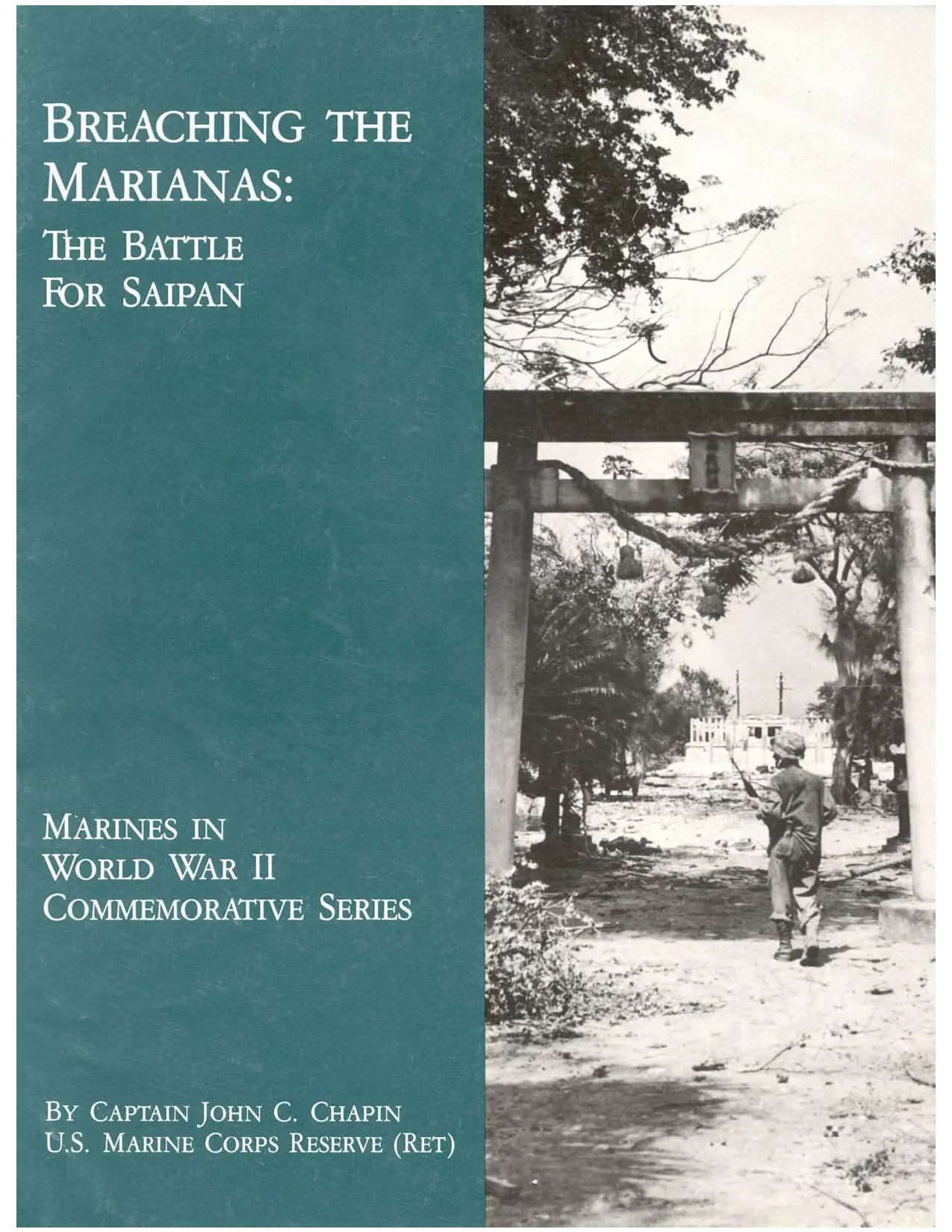
About this series: Breaching the Marianas pamphlet was originally published in 1994 as part of the Marines in World War II Commemorative Series. All titles from the series are now in the public domain and available for public access. The written pamphlet (40 pages) includes pictures and maps; a digital version was accessed from Marines.mil. The video (1:54:29) is an audio version read by a Librivox.org volunteer.
Breaching the Marianas: The Battle for Saipan
by John C. Chapin

Facts: On June 19, 1943, Ticonderoga, NY native Ruth L. Wood enlisted in the Marine Corps. After six weeks in bootcamp, she was assigned duty. As noted in the Lower Adirondack Regional Center or Lark interview of Wood, near 18,000 women in the Marine Corps freed up enough men from office work to create 6th Marines. The 6th, under 2d Marine Division would serve in Guadalcanal, Tarawa, Saipan, Tinian and Okinawa.
Wood would go on to become the first woman Marine to be a chief warrant officer. More about her experience can be found at https://larchny.org/ruth-l-wood-proud-to-be-a-u-s-marine/.
The Marine Corps is a fine career for a woman, and I highly recommend it.
Ruth L. Wood USMC (Ret)
Leave a Reply