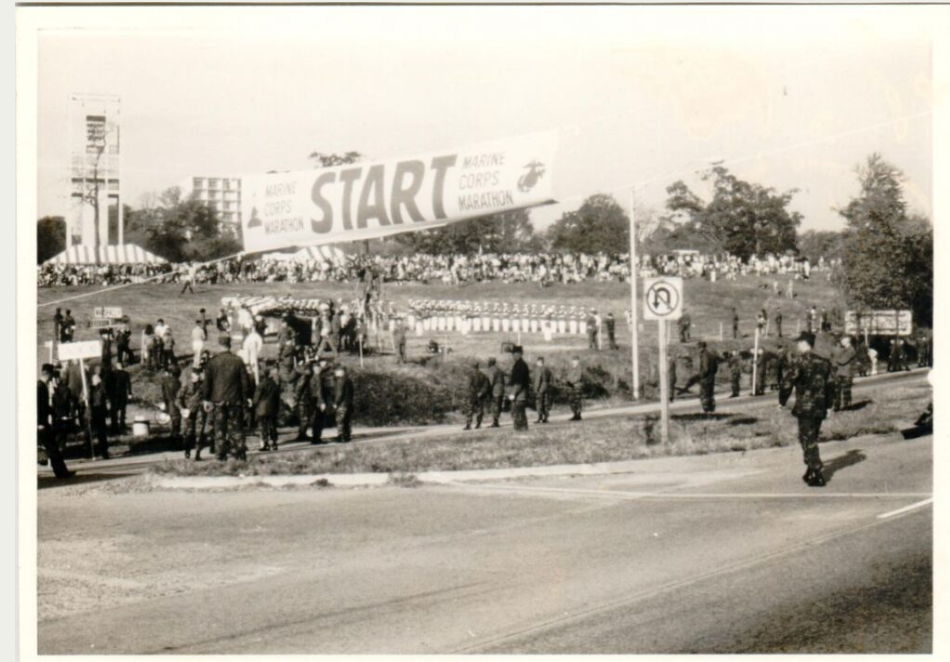
On November 7, 1976 the inaugural marathon was open to 1,175 runners. On October 26, 2025 the 50th Marine Corps Marathon reaffirmed The People’s Marathon is a popular choice for first time marathon runners.
Although an unverified statistic, some estimate only 1% of the population will complete a marathon in their lifetime. Amongst the present membership, three have run the Marine Corps Marathon at least once. For all of us, it was our first marathon.
In 1984 or 1985 and on active duty, Clayton Menser Sr was intrigued to hear about a female corporal in his unit who had ran it. She shared how much fun it was. A captain in the unit dared Clayton to run it. So he started training.
Clayton prepared training on base six days a week. He would run the base perimeter as his yardstick of 11 miles. He once ran it twice with no water. His staff NCO sent him off with a running outfit to wear during the marathon. He’d prepared to complete the marathon in under three hours.
Clayton signed up for the runners clinics offered through the marathon website. At the clinics (which usually occur the weekend of the marathon) the instructors pushed the benefits of certain electrolyte drinks for running and recovery. It wasn’t until mile 16 or 17 Clayton’s new found electrolyte drinks led to severe leg cramps. For the last nine or so miles he now balanced running and alleviating a barrage of cramping. Repeatedly he stopped to massage them out before getting back up and finishing the race.
At the finish line his wife Karen had a space blanket ready for him. All he could do was lay down and massage out more cramps from his legs. His wife kindly found him a banana and a beer to celebrate achieving the milestone, cramps and all. It was only in the post seminar where it was shared the electrolytes were only good if you built up to them.
Paul Tremblay has run 5 marathons and all of them have been the Marine Corps Marathon. He ran his first in 1989 and ran again in 1990. 1991, 1992 and 1993. On active duty, Paul had always earned a first class physical fitness test score. He always finished the run portion in under 18 minutes.
Paul ran cross country in high school, he ran in the Marine Corps (and served often as a motivator to other runners) so it seemed natural when he left the service that he would keep running. Although he never joined the Syracuse running club, he ran with them for fun, then competitively. He served as a pacer for many of the club runners when one of them shared with Paul there was a marathon in Washington D.C.. It was the first time Paul had heard of the Marine Corps Marathon. He trained and served as ground support to many of the club the first year. On the sidelines he saw Marines all over and he felt a closer to home while in proximity to these Marines. When he saw 8th and I Marines running by and singing cadence, Paul knew he was on the wrong side of the line.
The next year he crossed the finish line at 6:20:47 and by his final marathon he crossed at 3:41:41. Paul attributes his success from preparation, determining his purpose to run it and by finding someone who ran better than him and putting in the effort to keep up. As an experienced finisher Paul advises those who are considering it, “Just like in the Corps, training is everything. It’s muscle memory. There are motivators along the way to keep you going.”
The final member who ran the Marine Corps Marathon did so in 2014. Kelly had no ambitions to run a marathon but living in the Washington D.C. area it seemed so many had run one. Tired of waffling back and forth to do it or not, she concluded if she was going to do one it was going to be the Marine Corps Marathon or nothing. So she entered the marathon lottery and waited. If she was selected, she would run; if not, she would not think about running a marathon again.
When Kelly got a bib number she realized she had to prepare. Her goal was to complete it without injury. It was her 40th birthday present to herself. When Kelly started asking around from those who’d already run one she realized to conserve time and be successful, she needed to find an expert for advice. While in the Marine Corps and out, Kelly has always sought to hang out with Marines who are better Marines than her. One such case is her friend Mike. She called Mike and said, I need help getting started. He is the most accomplished athlete she knows and after two or three questions and about five minutes he gave her a clear path.
She realized she could do everything needed but she decided she would rather train than learn to design her training schedule so she outsourced that to runcoach.com. Kelly then became very strict about her food, liquids and consistent training schedule. Her only error in training came from running the Prince William Forest Park half marathon trail run. With a painful knee injury it was unclear if she would heal to run the road race. Further research led her to continue running in a pool until she could put full weight back on her knee.
Kelly finished at 6:08. While she was not surprised by the demanding last 0.2 miles to the finish line (that’s 100% Marine Corps), she was overwhelmed by the sight of the Iwo Jima Memorial. Kelly had learned from Mike to dedicate her run and do it for someone else and she had dedicated this run to her grandpa who was a Marine on Iwo Jima in WWII. Seeing the memorial wiped all the pain out of her and in that moment she was left with greater respect and admiration for all the Marines who were on Iwo Jima.
Facts: In 2014 Marine Medal of Honor recipient Kyle Carpenter skydived to the start of the Marine Corps Marathon and ran it. He finished in 5:07:45.
Leave a Reply